
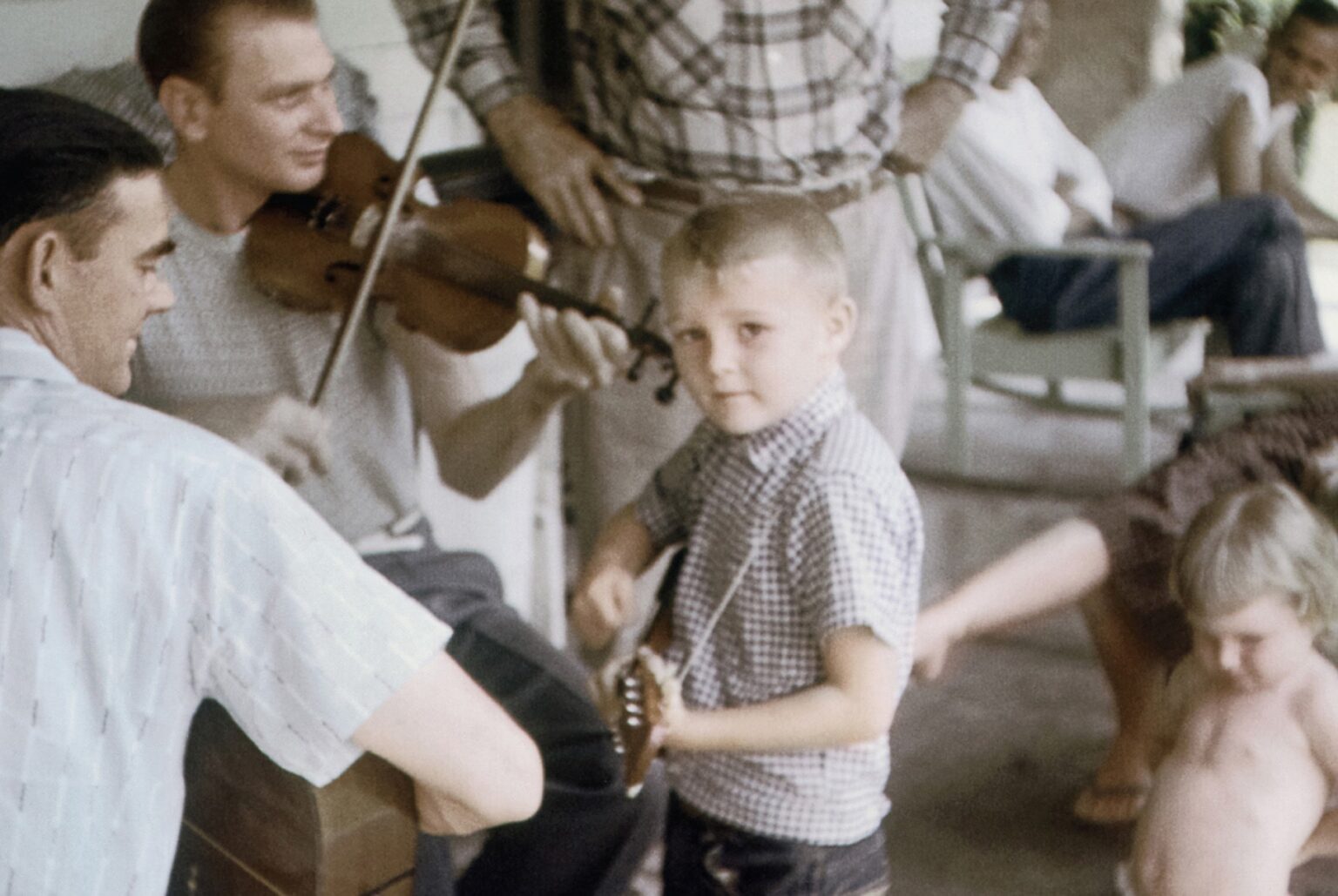
Ricky Skaggs and the Sound That Was Always Already There
Some musicians spend a lifetime chasing a sound.
Ricky Skaggs was born with his.
He grew up in the mountains of eastern Kentucky, where he heard his parents sing, listened to their bluegrass 78s, and soaked up country sounds drifting in off the radio. That was his education before he ever set foot in a classroom. And it turns out, it was the only education that mattered.
When Ricky was five, his father Hobert gave him his first mandolin. Two weeks after teaching him three chords, Hobert returned home from working out of town to find his young son already making chord changes and singing along.
Two weeks.
That’s the kind of thing people say about somebody before they use the word prodigy.
A Six-Year-Old and a Legend’s Mandolin
The story that people from these hills still tell — the one that tends to stop a room — happened when Ricky was six years old.
Bill Monroe, the father of bluegrass himself, came to Martha, Kentucky for a performance. The crowd wouldn’t let up until “Little Ricky Skaggs” got up to play. Monroe called the boy forward, placed his own mandolin around Ricky’s neck, and adjusted the strap to fit his small frame.
Think about that for a second.
Bill Monroe’s mandolin. On a six-year-old from a Lawrence County holler.
Ricky later wrote about it in Guideposts magazine: the crowd went wild, clapping and hollering for their hometown kid. Folks would bring it up for years afterward at church socials and county fairs. “You’re the young fellow who played Bill Monroe’s mandolin.” He’d nod and feel a sense of pride. Not cocky pride, but the good kind.
The good kind. That’s an eastern Kentucky answer if there ever was one.
By the time Ricky was seven, he walked onto the stage of the Ryman Auditorium as a special guest on Flatt & Scruggs’ Martha White Flour Hour and performed two songs, including “Foggy Mountain Special.” In footage you can still find on YouTube, seven-year-old Ricky walks up to Lester Flatt and announces he wants a turn to “pick,” then lights into the song and absolutely stuns the room.
Lester Flatt’s response? “He wasn’t kidding when he said he wanted to pick. You done a fine job.”
High praise from a man who didn’t hand it out lightly.
A Flat Tire That Changed Everything
Here’s where the story gets the kind of turn you couldn’t write if you tried.
Ricky Skaggs was born on July 18, 1954, only two weeks after Keith Whitley’s birth on July 1 of that same year. Two eastern Kentucky prodigies, practically born in tandem, who wouldn’t find each other until fate and a talent show put them in the same room.
In 1969, at a musical contest in Ezel, Kentucky, Skaggs and Whitley met and hit it off immediately. Two teenagers who were both head-over-heels for the Stanley Brothers at a time when most kids their age were chasing something else entirely.
Then came the flat tire.
As teenagers, Whitley (15) and Skaggs (16) were discovered by Ralph Stanley, who arrived 45 minutes late to a performance because of car trouble. When Stanley walked through the door, he heard what he thought was a jukebox playing the Stanley Brothers. It wasn’t a jukebox. It was two Kentucky boys doing what came natural.
Stanley was so moved that the duo had modeled themselves after the Stanley Brothers, and done so convincingly, that he invited them to join his group on the spot.
A flat tire. Forty-five minutes. Two mountain kids who knew every note well enough to fool the man who wrote them.
From the Hills to the Charts. And Back Again.
By the end of 1981, Skaggs had become a full country star and, in the process, had brought traditional roots music back into the mainstream. Over the next five years, he was a major artistic and commercial force, with a string of Top 10 singles, CMA awards, and Grammy-winning albums. Between 1982 and early 1983, he had five straight No. 1 singles.
Garth Brooks, who helped induct Skaggs into the Country Music Hall of Fame, credited the Kentucky native for paving the way for Randy Travis and the traditionalist movement. “There was a cowboy out of Texas holding the fort down and a cowgirl out of Oklahoma holding the fort down, and they needed help,” Brooks said, referencing George Strait and Reba McEntire. “Here came a kid playing country and bluegrass music out of Kentucky. And I think George, Reba and Ricky held the fort down long enough for traditional country to make a comeback.”
But Nashville’s shine was never quite bright enough to keep him.
Just before Bill Monroe died in 1996, Skaggs made him a promise: he would do his part to keep bluegrass alive. He kept it. He walked away from the mainstream, formed his own label, Skaggs Family Records, and went back to the music he was born into.
He won his sixth Grammy with the label’s first release, Bluegrass Rules, which also took the International Bluegrass Music Association’s Album of the Year. The boy had come full circle. Right back to the mountains. Right back to where it all started.
A Little Bit of Controversy Never Hurt a Good Story
No storyteller worth their salt leaves out the rough parts.
Ricky Skaggs has never been shy about his Christian faith, and over the years, that outspokenness has put him on the receiving end of some real criticism. In 2021, comments he made in an interview about politics and faith sparked a heated debate across the bluegrass community, drawing strong responses from fans and fellow musicians alike.
But here’s the thing about Ricky Skaggs that his fiercest critics tend to overlook: the man spent his entire career opening doors, not closing them. He produced Dolly Parton’s comeback album. He mentored artists across genres. When TMZ once tried to ambush him outside the Grand Ole Opry hoping to get him to say something ugly about two artists who had just come out as gay, Skaggs didn’t take the bait. That’s worth noting too.
He’s complicated. He’s opinionated. He’s stubborn about what he loves.
Sounds like someone from eastern Kentucky.
Why Ricky Skaggs Belongs on This Highway
In 2018, Skaggs was inducted into the Gospel Music Hall of Fame, the Musicians Hall of Fame, the National Fiddler Hall of Fame, the IBMA Bluegrass Music Hall of Fame, and the Country Music Hall of Fame. All in the same year.
Fourteen Grammy Awards. Dozens of number ones. A legacy that touched bluegrass, country, gospel, and everything in between.
And it all started right here. In these hills. With a little boy, a borrowed mandolin, and a crowd that wouldn’t let him sit back down.
Along U.S. 23, we tell the stories of artists who carried something out of Appalachia that the world needed to hear. Ricky Skaggs didn’t just carry it out. He carried it back.
That’s the full circle. That’s the story.
And if you ever want to hear where it began, just come find the mountain.
📍 Explore more stories from the Country Music Highway at paintsvilletourism.com